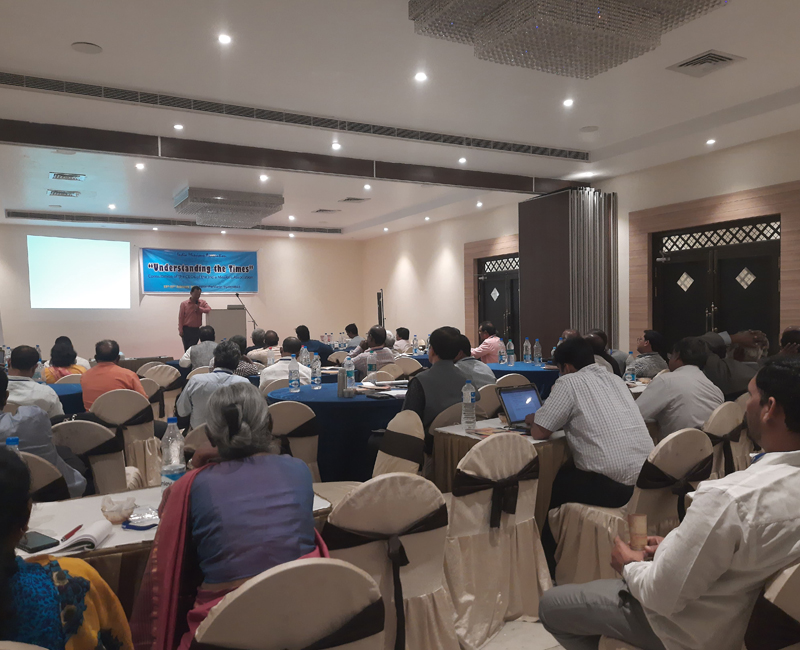
1977 – All India Congress on Missions & Evangelism (AICOME) was held at Devlali, Maharashtra organised by the Evangelical Fellowship of India
1977 – An Ad Hoc Committee was appointed to follow up the recommendation of AICOME for the formation of a Missions Association. Original Steering Team – Ad-hoc Committee Members
Mr. John Richard, EFI – (Chairman)
Rev. Theodore Williams, Indian Evangelical Mission (General Secretary)
Mr. R. Stanley, Full Gospel Young Men’s Association (Blessing Youth Mission) – (Treasurer)
Rev. Lalthankhum Sinate, PMS
Mr. N. Emil Jebasingh, Friends Missionary Prayer Band
Mr. D T Rajah, Fellowship of Evangelical Friends
Mr. Thomas Samuel, Quiet Corner India
Rev. Henry Joseph, Maranatha Full Gospel Association
India Missions Association was formed with Six member missions
1978 – The first Annual General Meeting (AGM) and the first Annual Conference was held at Quiet Corner, Mavanahalla, Nilgiris, Tamil Nadu.
1979 – IMA was registered as a Society under the Karnataka Societies Registration Act of with its registered office at 38, Langford Road, Bangalore.
1980 – IMA Membership grew to ten members
1980 – Indian Institute of Cross Cultural Communication – The Bible Translation & Literacy Network was formed by IMA in partnership with SIL / WBT
1982 – The First Mission Leadership Training was conducted
1983 – The Unreached People’s Survey was initiated
1985 – Mr. Ebenezer Sunder Raj appointed as Associate General Secretary
1986 – IMA Office was opened at Chennai
1990 – The First Management Seminar
1990 – The First National Consultation on Evangelism
1990 – The IMA Membership grew to 44 members
1992 – The Missionary Training Network was formed
1993 – Missionary Healthcare Network formed
1994 – The Indian Institute of Missiology was founded on September 20, 1994
1994 – The Pin Code Survey of the presence of Christian workers was launched
1994 – IMA and The National Council of Churches in India (NCCI) jointly hold a Partnership Consultation and issue a Joint Statement on Partnership in Nagpur.
1996 – Dr. K. Rajendran was appointed as Associate General Secretary.
1998 – IMA Delhi office opened with Mr. John Amalraj appointed as Coordinator
1998 – Indian Missions Alliance Among Neighbours’ Network (IMAAN) was formed
1998 – 14 acres of Land Purchased for the development of IMA Centre at Hyderabad
1999 – Christian Institute of Management (CIM) was formed
1999 – Dr. K. Rajendran was appointed as the General Secretary
1999 – IMA Membership grew beyond 100 members
1999 – For the Annual and all IMA gatherings CEOs were welcomed to bring their spouses, their second line leaders and their children above 18 to start the exercise of building second-line leadership and creating wider understanding of missions and leadership. It created a new organisational culture.
2000 – IMA Membership grew to 130 members.
2001 – IMA Guwahati office opened with Mr. Lalparlien Kumar appointed as coordinator
2002 – IMA Hyderabad Office opened with Mr. John Amalraj appointed as Team Leader 2002 – A part of the IMA Centre land was approved by the State Government for the purpose of institutional use
2002 – IMA Silver Jubilee Celebrations was inaugurated at Bangalore.
2002 – The First IMA Annual Awards were presented Life Time Achievement Award and Mission of the Year Awards in six categories
2002 – IMA Membership grew above the 150 mark.
2003 – Dr. K. Rajendran shifts the office from Chennai to Hyderabad.
2003 – IMA releases a booklet on missions’ best practices after discussion by the member mission CEOs in the national conference.
2003 – Think-tanks on mission issues became regular parts of the IMA Activities.
2004 – National Youth Leaders conference was held at Hyderabad to reach Indian Youth.
2005 – Think-tanks on women in mission, emerging church planting and Younger CEOs became the benchmark for missions’ movements.
2005 – IMA Membership crosses 200th mark.
2005 – First MK camp was conducted by IMA at Pune.
2006 – Historical IMA National conference for the first time was held in Aizawl, Mizoram, recognising the unique contribution of the Church and missions in North Eastern India who have the potential to reach East Asia to begin with.
2007 – IMA National conference was held in Dehradun, Uttrakhand, North India during 3-5 May 2007.
2008 – IMA National conference was held in Hyderabad.
2009 – IMA National conference was held in Bangalore.
2010 – Rev. Sussnta Patra was appointed as the General Secretary
2011 – IMA National conference was held in IMA Vision City, Hyderabad during 13 – 17 Sept 2011.
2012 – IMA National conference was held in IMA Vision City, Hyderabad during 20 – 23 Sept 2012.
2013 – IMA National conference was held in Chennai.
2014 – Dr. Theodore Srinivasagam was appointed as the Interim General Secretary
2015 – Rev. Dr. Wati Longkumer was appointed as the General Secretary
2016 – IMA National Conference was held in IMA Vision City, Hyderabad during 26th – 28th July 2016.
2017 – IMA India Mission Summit was held in IMA Vision City, Hyderabad during 6th – 8th September 2017.
2018- Historical IMA event India Mission Summit hosted by Ao Baptist Church Diphupar ( ABCD) at 31st Aug- 2nd Sep 2018 at Dimapur, Nagaland
2019- IMA India Mission Summit was held in AGLC, Hyderabad during 27th-30th Aug 2019
2020- Nation wide lockdown due to Covid 19. Started from 24th March 2020. Staff worked from home
2020- Due to Covid 19 IMA Annual General Meet held for the first time on virtual over zoom on 22nd September 2020
2021- Due to Covid 19 IMA Annual General Meet held on virtual over zoom on 22nd September 2021
2021- IMA Membership grew to 284 members
2022- Rev. Dr. Isac Soundararaja appointed as General Secretary on 31st March 2022